Where have all the conservatives gone?

Michael Rentiers • August 1, 2025
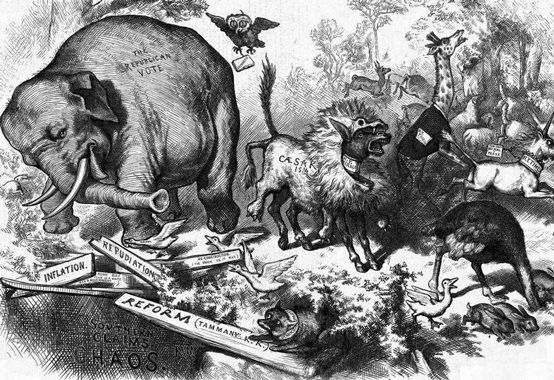
A black and white drawing of an elephant surrounded by animals.

Where have the conservatives gone

For a long time, conservatism and the GOP have been branching apart. In a generation, scientists won’t be able to tell that we ever shared a family tree.

 Hello, my name is Michael, and I am a conservative.

But, where are the others? There have to be plenty of us who share an ideology. I can’t be alone. I think differently, but not that different. My background is atypical for a conservative, but that does not account for anything. I developed a rebellious, nonconformist worldview — but that is the heart of conservatism.

This article was to be a brief introduction to my political ideology. When I couldn’t name many contemporary conservative voices to reference, this morphed into a juxtaposition piece between conservatism and the theatre of the absurd portrayed on TV and embodied by the loudest voices in the Trump movement.

So, start again, shall we?

Hello, my name is Michael, and I am a conservative.

When you read that sentence, I bet your mind conjured up a caricature of me. It has nothing to do with who I am, but the media has reduced us to political cartoons with exaggerated features. You hear Conservative or Liberal and think of a person who is nothing like you and has nothing to offer but wrong opinions. Almost non-human.

I have nothing in common with the politics we see in the news or online. It’s the Upside-Down from the series Stranger Things. In reality, it’s all a show designed to turn the news into a commodity ($$$). It is lock, stock, and barrel the political WWE. Those putting on the show are in on it, and the politicians (performers) are in on it. The talking heads and everyone else are all in on it. You know it’s true.

My ideology has no relation to daily news or even Republicanism. Call it Trumpism. In fact, both parties have cut moorings with objective truth completely. They don’t care about the rule of law — it’s enforcing a worldview centered on power. Those with power know making tough decisions and solving problems make it harder to hold onto said power. So they use wedge issues to divide us and make us angry, and that makes us stupid and easy to manipulate

Modern politics runs on craven hunger for power. The ends always justify the means — ignoring the Constitution or storming the US capitol — all excusable in pursuing power. Helluva a day’s work, if you can get it, Chief.

And why stop when it’s working? If I was a soulless demon, I wouldn’t. We must stop being manipulated. You have to speak out. Remember, the news is an entertainment commodity, and you are a consumer. Until they hear you, the show goes on.

So what is conservatism to me? I believe in preserving the philosophy of the Revolution. Conservatism was established with the Declaration of Independence. It was made real in the Constitution. Our hymnal is the gospel of the Federalist Papers.

We get criticized for hating change, and it’s a valid criticism. It is easy to just say no, but you have to find a way to say yes sometimes to govern. Change must be constitutional, not half-cocked proposals fueled on outrage and loaded with pork, but change is not bad.

I read what the Framers read, what they wrote, and what they studied to form my worldview. I read the State of Nature, discussions on the social contract, and ideas like the consent of the governed. I read french democratic philosophers like Voltaire. Reading Wealth of Nations, I understood the rationale for capitalism and its pitfalls. Finally, I believe the Federalist Papers are a seminal read for all Americans.

I believe our nation is unique. Instead of consolidating power, as almost all revolutions do, the Framers divested control quickly. They created a system of equilibrium and equality of opportunity (slavery will always be our original sin and we must not be afraid to discuss it rationally because it’s legacy is still with us). The brilliance lies in the design being underpinned by an understanding of human nature.

Unlike the bloody foolishness of Marxism, which assumes that all men are angels, the American way pits our worst instincts against itself. As a defense-in-depth, a divided government creates layers of checks and balances. Federalism, bicameralism, and the Bill of Rights established tension. That tension created balance and fairness. If my rights are interdependent on your rights, there’s a mutual interest in the status quo. Add a melting pot culture, and we have a flexible but sturdy system.

We’re a bunch of selfish bastards, but if you mess with one, you get us all. I liked that when we used to believe it.

So what’s cracking the system now? What has changed?

John Adams sums it up:

“Our Constitution was made for a moral and religious people. It is wholly inadequate to the government of any other.”

Adams also said:

“Human passions unbridled by morality and religion…would break the strongest cords of our Constitution as a whale goes through a net.”

Adams articulates a universal truth — Mankind is not evolved enough to live in a completely free society. Society would crumble with no moral compass or ethical guideline to check our worst instincts. However, we cannot govern through faith and emotion. As Jedi say in Star Wars, emotion leads to the dark side. Remember, the road to hell is paved with good intentions.

Collective morality and ethics are necessary checks against the state of nature. Without it, the state must step in as God. No more sin, but everything is illegal and punishable by death. No one wants that.

At the end of the day, conservatism isn’t easy. Without intellect and discipline, it can be dangerous. It requires we hold opposite but not opposing views at the same time. For example, I believe in delayed gratification and acting selflessly, but I am also selfish. I am independent but willing to serve. I resist government control, but I will do my duty to sacrifice if required by my nation.

I believe that a high-performing, limited government, coupled with a strong culture that guides the behavior of the collective, is the best way.

Man is always the weak link in any system. When our system fails us, it is we who fail the system.

News & Opinion

By Michael Rentiers January 15, 2026
Businesses have long understood the value of lobbying, coalitions, and direct engagement with policymakers. That world still exist...it still matters, but the the most powerful way to shape public policy is by harnessinb Public policy today is shaped in two parallel arenas: inside legislative chambers and outside them, where public understanding, voter pressure, and narrative momentum are formed. Increasingly, that second arena is digital. Political and advocacy spending tells the story clearly. Billions of dollars now flow into digital political advertising, issue advocacy campaigns, and online persuasion efforts. This isn’t accidental. Digital channels offer something traditional advocacy never could: precision, speed, and scale. Digital advocacy allows businesses to reach specific audiences—voters, community leaders, employees, regulators’ constituents—with tailored messages about how policy proposals affect jobs, prices, innovation, and economic growth. It allows organizations to explain complexity, counter misinformation, and elevate pro-business perspectives before legislation is locked in. Just as importantly, digital influence is measurable. Engagement, reach, sentiment, and message penetration can all be tracked and adjusted in real time. That makes digital advocacy not just powerful, but accountable. Meanwhile, lobbying spending continues to hit record highs. That tells us something important: shaping policy is expensive, competitive, and increasingly crowded. In that environment, relying solely on behind-the-scenes influence leaves value on the table. Public opinion still matters to policymakers. Voters still matter. And voters increasingly learn about policy online. Businesses that invest in digital advocacy aren’t abandoning traditional influence—they’re amplifying it. They’re reinforcing their position in the places where narratives are formed, pressure is applied, and legitimacy is built. Public policy will continue to shape markets, labor, energy, technology, and growth. The question isn’t whether businesses should engage. It’s whether they will engage where influence actually happens. Today, that place is digital.
By Michael Rentiers January 13, 2026
For decades, businesses understood information flow through a familiar lens: television, newspapers, maybe radio if you were feeling ambitious. That mental model is now dangerously outdated. It can't be a surprise that the overwhelming majority of Americans get their news digitally - via phones, tablets, or laptop. Online news comes from a myriad of sources, usually a mix of websites, social platforms, and influencers from an algorithm-driven feed. For younger and mid-career adults, social media and digital news sources don’t supplement traditional media; they replace it. Television remains influential with older audiences, but even that dominance is eroding as streaming, short-form video, and mobile news reshape habits. This matters for brand protection. Reputational risk no longer breaks on the evening news. It breaks online, in real time, often before a journalist is even aware something is happening. Narratives form quickly, spread faster, and harden long before a press release can catch up. If your organization is not actively participating in the online information ecosystem—monitoring it, shaping it, correcting it—then others are doing that work for you. And they may not be friendly. Digital platforms are not just distribution channels; they are arenas of influence. Search results, social feeds, comment sections, and shared articles collectively determine what stakeholders believe about your brand. Silence is no longer neutral. It’s a vacuum. The smartest organizations have already adjusted. They think of digital communication as a form of infrastructure—something that must be maintained, stress-tested, and strategically designed long before a crisis hits. They invest in online presence not because it’s trendy, but because it’s where public understanding is formed. TV and print still matter. But they are no longer the center of gravity. If your brand protection strategy still assumes that influence flows top-down from traditional media, you are defending yesterday’s battlefield. The conversation has moved online. That’s where credibility is built, challenged, and either protected—or lost.
Despite costing the business world billions annually, we still refuse to proactively invest in publi
By Michael Rentiers December 5, 2025
Despite costing the business world billions annually, we still refuse to proactively invest in public relations.
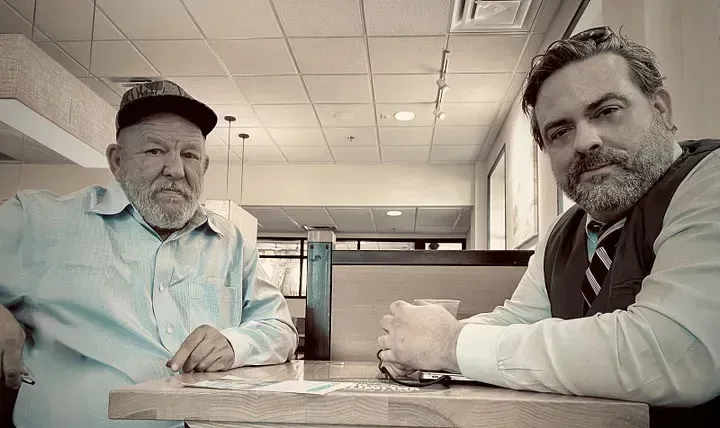
Daniel, a Vietnam Veteran and I having lunch.
By Michael Rentiers December 4, 2025
The last few years have taken me down a path I never expected. During the early days of COVID, when the world felt suspended and my professional work slowed, I found myself working out of a small café in Columbia, SC. One afternoon, a homeless man approached and asked me for money to buy lunch. Instead, I invited him to sit with me. Over sandwiches, he shared his story. He was a Vietnam veteran whose life had unraveled in ways that were gut wrenching to hear and, as I would learn, far too common. I went home and dug into the facts about veteran homelessness. The statistics were jarring, and now they had a face and a name, Daniel. His story stuck with me. I’ve never been one to sit idly by, stepping up never scared me. But what could I possibly do? The answer was simple. Do something. Do anything. Afterall, what have those guys done for me? More than I could ever repay. I kept hearing the same words echo in my mind: If I am only for myself, who am I? If not now, when? I had done PR work for veteran causes before, but this time professional experience didn’t feel like enough. I felt compelled to act personally. So I began spending time on the streets around Columbia, building relationships with the men who had served our country only to have our country fail them. That led to the creation of Without Heroes, a nonprofit dedicated to working directly with homeless veterans one relationship at a time. My theory was simple: transformation begins with consistency and trust. The plan was to intervene in their lives individually to provide the support they need to reach stability. Even if I could only impact one life at a time, that was still meaningful change. Time has passed quickly. The work has been challenging, profound, and humbling. It changed how I see people. It changed how I see service. And it changed how I see the responsibility that comes with having skills that can make an impact. However, I’m returning to my professional world with renewed purpose through my new communications firm, CTA Communications. It’s named after my experience, a Call To Action. I’m bringing back everything I’ve learned…about people, about storytelling, about advocacy, and about what it means to respond when the moment calls. Without Heroes will go on. There is so much work to be done, but it’s time for the next chapter and a return to doing what I love. If you’re interested in getting together, get in touch!
More Posts