Dirtiest Word in Politics: Compromise

Michael Rentiers • August 9, 2025

How many of you are politically engaged and have bad-mouthed a politician in your party for being open to compromise?

I know there are many of you; it’s become almost a litmus test in primary elections.

I’ll give you the punchline upfront because this isn’t a setup. I’d like you to learn rather than beat you up about it because you’re flat-out part of the problem. You are contributing to the downfall of the most ingenious system of government ever to be established.
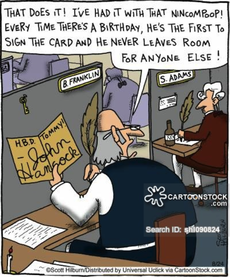
Hancock’s ego is on display

I am not only wagging my finger at the right. The two parties are mirror images of one another regarding destructive behavior. There exists within both parties — thus the American people — a thread of willful ignorance that partisans wield like a weapon against rational thought.

Right now, fewer and fewer people, regardless of age, have even a basic understanding of how our system of government works, nor are they familiar with the rationale of the people who created it. Without the basic understanding, there is no shock that our current actions are snapping the bonds that connect us.

I’ll spare you the deep dive into democratic republicanism. (Even the name combines the two parties.) I will instead point you to the founders themselves. If you look at the documents, they produced. At the letters they wrote to one another, speeches they gave, you’d understand one thing — there was never a unified sentiment, and that meant they would never allow a tyranny of the majority. Jefferson was an uncompromising zealot. Yet he penned the world’s two most well-known compromises.
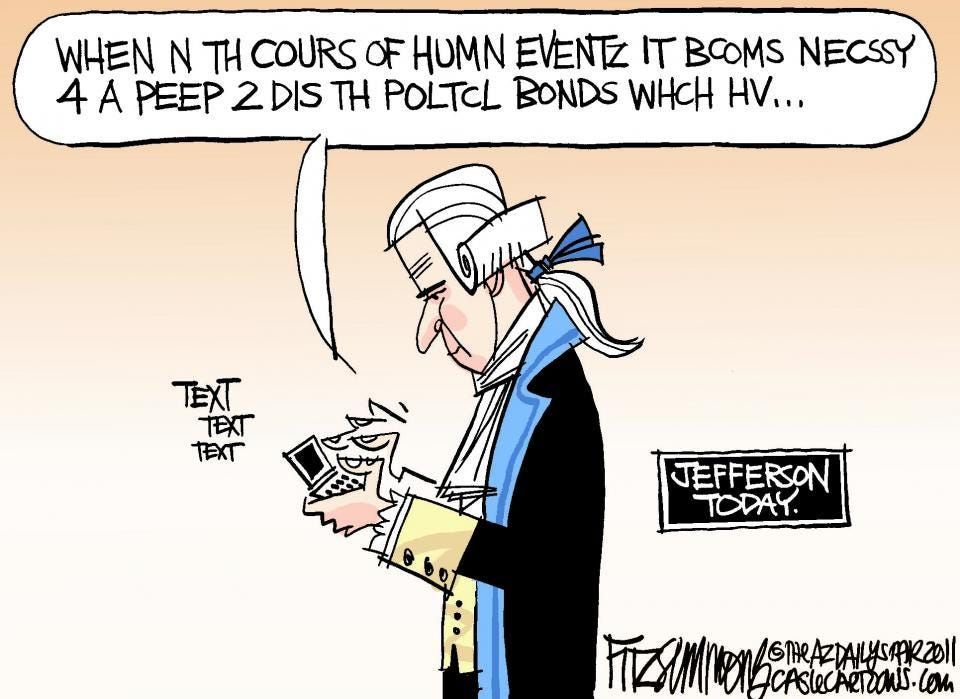
Even our government is a glaring recognition of compromise. Federalism consists of two competing systems of government — compromise was and will always be the lifeblood of our Democracy.

Why do we have a proportional House but an equally distributed Senate? Why a strong national and state government? Even our political parties served as coalition builders where factions disagreed but came together in compromise to form a governing majority.

A compromise was never the end of a politician till now. This trend of shunning a politician for compromising has become a destructive force wielded by those craven for power and the stupid who don’t know or care.

President Reagan was outspoken on compromise. From his autobiography, “An American Life” (Simon & Schuster, 1990), Reagan wrote about his time as Governor of California.

“Compromise” was a dirty word to them, and they wouldn’t face the fact that we couldn’t get all of what we wanted today. They wanted all or nothing, and they wanted it all at once. If you don’t get it all, some said, don’t take anything.
If you got seventy-five or eighty percent of what you were asking for, I say, you take it rather than going over the cliff with your flags flying.

Oh, how we could use that kind of leadership today.

I’ll leave you with one of the most glaring examples that compromise is in the fabric of our government. I invite you to read our most sacred document — The Declaration of Independence. It is a document so powerful it held thirteen independent states together, established this nation, and almost tore us apart as we finally ended the barbaric idea that one man could own another in the Civil War.
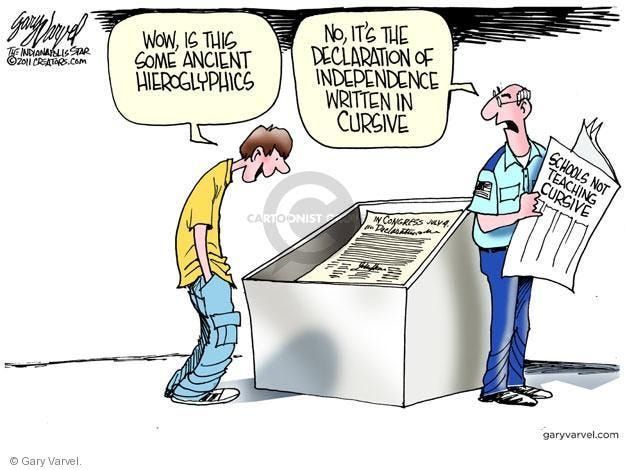
Yet, that same document is an oddly cobbled together compromise. Our framers fought over just what this was supposed to be and how it should be written. Some states felt a deep loyalty to the Crown, while others engaged in a counter-insurgency against British troops. They all worried about how hard to push the King. They were wise to be cautious. They could not just undermine the idea of the monarchy. On the one hand, their King refused to listen. But to win independence, they would need recognition and help from other monarchs.

If you have never read the Declaration, I beg you to take a moment and do so. As esoteric as I sound, it is the very reason you and I do not live in fear of persecution, hunger, or war on our soil. Not all are so lucky — today, now, the majority of the world’s population still lives under constant threat of death from oppression, starvation, curable disease, and wars with no cause.

Maybe you can take a moment?

You might not see it on the first pass, but it is a jumble of revolutionary statements mixed with legal arguments, some hedging of bets, and gnashing of teeth. We all know the preamble that lays out man’s inalienable rights in a brilliant revolutionary statement. It just as forcefully becomes a technocratic legal argument right after. At times it is almost apologetic to the Crown. I hope you read the damn thing.

We could continue for hours on making the constitution and compromise, but the point is made, and the dead horse, freshly whipped.

To all partisans who attack one other with childish name-calling. To those who think a purity test for primary candidates is healthy. And to those who cannot fathom that a Republican from the midwest differs from one in the South or a Democrat in the South differs from those in New England — America’s founding fathers, as well as every great President that as ever served, would like for you to shut the f*ck up and stop ruining everything.

Peace.
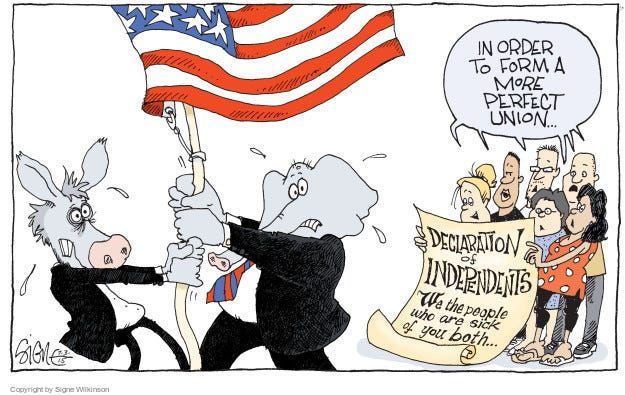
If you want to know more about why our systems depend on compromise or how the framers use our worst instincts to create a stabilizing tension in the design, please ask, and let’s discuss it. We are losing so much institutional knowledge, and it’s because those who control the education system are removing it. I am serious when I say that academia in the US is actively subverting the country, which could be outright treason. There is only one reason they have stopped teaching the foundational principles of the USA, and that’s because the only way it fails is from within. These extremists cannot win at the ballot box, so they subvert children’s minds — a long story for another day soon.

News & Opinion

By Michael Rentiers January 15, 2026
Businesses have long understood the value of lobbying, coalitions, and direct engagement with policymakers. That world still exist...it still matters, but the the most powerful way to shape public policy is by harnessinb Public policy today is shaped in two parallel arenas: inside legislative chambers and outside them, where public understanding, voter pressure, and narrative momentum are formed. Increasingly, that second arena is digital. Political and advocacy spending tells the story clearly. Billions of dollars now flow into digital political advertising, issue advocacy campaigns, and online persuasion efforts. This isn’t accidental. Digital channels offer something traditional advocacy never could: precision, speed, and scale. Digital advocacy allows businesses to reach specific audiences—voters, community leaders, employees, regulators’ constituents—with tailored messages about how policy proposals affect jobs, prices, innovation, and economic growth. It allows organizations to explain complexity, counter misinformation, and elevate pro-business perspectives before legislation is locked in. Just as importantly, digital influence is measurable. Engagement, reach, sentiment, and message penetration can all be tracked and adjusted in real time. That makes digital advocacy not just powerful, but accountable. Meanwhile, lobbying spending continues to hit record highs. That tells us something important: shaping policy is expensive, competitive, and increasingly crowded. In that environment, relying solely on behind-the-scenes influence leaves value on the table. Public opinion still matters to policymakers. Voters still matter. And voters increasingly learn about policy online. Businesses that invest in digital advocacy aren’t abandoning traditional influence—they’re amplifying it. They’re reinforcing their position in the places where narratives are formed, pressure is applied, and legitimacy is built. Public policy will continue to shape markets, labor, energy, technology, and growth. The question isn’t whether businesses should engage. It’s whether they will engage where influence actually happens. Today, that place is digital.
By Michael Rentiers January 13, 2026
For decades, businesses understood information flow through a familiar lens: television, newspapers, maybe radio if you were feeling ambitious. That mental model is now dangerously outdated. It can't be a surprise that the overwhelming majority of Americans get their news digitally - via phones, tablets, or laptop. Online news comes from a myriad of sources, usually a mix of websites, social platforms, and influencers from an algorithm-driven feed. For younger and mid-career adults, social media and digital news sources don’t supplement traditional media; they replace it. Television remains influential with older audiences, but even that dominance is eroding as streaming, short-form video, and mobile news reshape habits. This matters for brand protection. Reputational risk no longer breaks on the evening news. It breaks online, in real time, often before a journalist is even aware something is happening. Narratives form quickly, spread faster, and harden long before a press release can catch up. If your organization is not actively participating in the online information ecosystem—monitoring it, shaping it, correcting it—then others are doing that work for you. And they may not be friendly. Digital platforms are not just distribution channels; they are arenas of influence. Search results, social feeds, comment sections, and shared articles collectively determine what stakeholders believe about your brand. Silence is no longer neutral. It’s a vacuum. The smartest organizations have already adjusted. They think of digital communication as a form of infrastructure—something that must be maintained, stress-tested, and strategically designed long before a crisis hits. They invest in online presence not because it’s trendy, but because it’s where public understanding is formed. TV and print still matter. But they are no longer the center of gravity. If your brand protection strategy still assumes that influence flows top-down from traditional media, you are defending yesterday’s battlefield. The conversation has moved online. That’s where credibility is built, challenged, and either protected—or lost.
Despite costing the business world billions annually, we still refuse to proactively invest in publi
By Michael Rentiers December 5, 2025
Despite costing the business world billions annually, we still refuse to proactively invest in public relations.
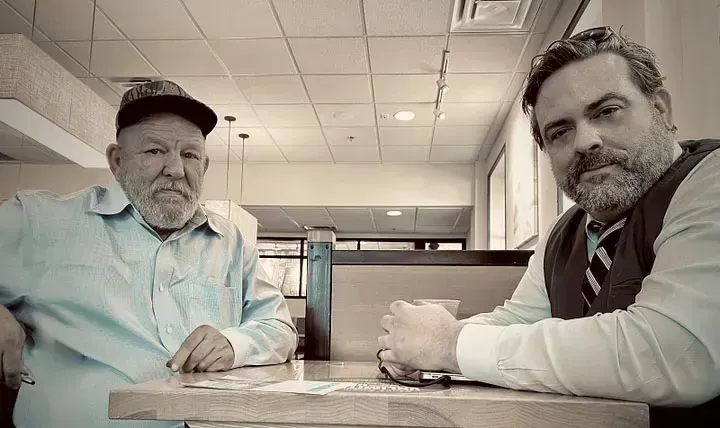
Daniel, a Vietnam Veteran and I having lunch.
By Michael Rentiers December 4, 2025
The last few years have taken me down a path I never expected. During the early days of COVID, when the world felt suspended and my professional work slowed, I found myself working out of a small café in Columbia, SC. One afternoon, a homeless man approached and asked me for money to buy lunch. Instead, I invited him to sit with me. Over sandwiches, he shared his story. He was a Vietnam veteran whose life had unraveled in ways that were gut wrenching to hear and, as I would learn, far too common. I went home and dug into the facts about veteran homelessness. The statistics were jarring, and now they had a face and a name, Daniel. His story stuck with me. I’ve never been one to sit idly by, stepping up never scared me. But what could I possibly do? The answer was simple. Do something. Do anything. Afterall, what have those guys done for me? More than I could ever repay. I kept hearing the same words echo in my mind: If I am only for myself, who am I? If not now, when? I had done PR work for veteran causes before, but this time professional experience didn’t feel like enough. I felt compelled to act personally. So I began spending time on the streets around Columbia, building relationships with the men who had served our country only to have our country fail them. That led to the creation of Without Heroes, a nonprofit dedicated to working directly with homeless veterans one relationship at a time. My theory was simple: transformation begins with consistency and trust. The plan was to intervene in their lives individually to provide the support they need to reach stability. Even if I could only impact one life at a time, that was still meaningful change. Time has passed quickly. The work has been challenging, profound, and humbling. It changed how I see people. It changed how I see service. And it changed how I see the responsibility that comes with having skills that can make an impact. However, I’m returning to my professional world with renewed purpose through my new communications firm, CTA Communications. It’s named after my experience, a Call To Action. I’m bringing back everything I’ve learned…about people, about storytelling, about advocacy, and about what it means to respond when the moment calls. Without Heroes will go on. There is so much work to be done, but it’s time for the next chapter and a return to doing what I love. If you’re interested in getting together, get in touch!
More Posts