Am I Racist?

Michael Rentiers • September 24, 2024

Not a movie review on the hit documentary by “The Daily Wire” — this is my commentary on being southern, the Confederate flag, & anti-racism in a changing south.
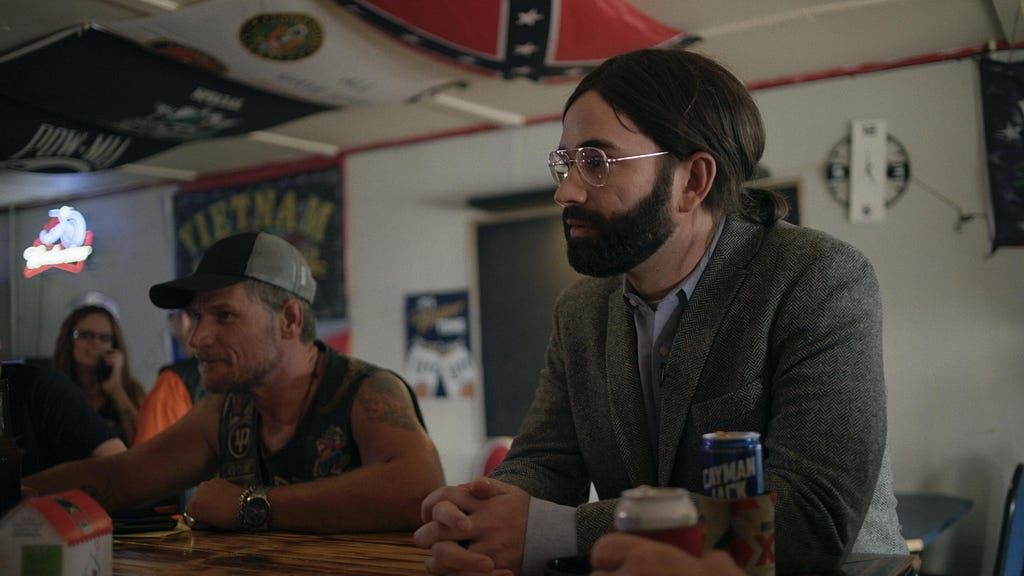
Scene setting: In the movie, Matt Walsh heads to the American South to hear what regular folks think of the latest brand of race-obsessed psychobabble infecting our nation. Honestly, the language does feel more Orwellian than NewSpeak itself, and the reactions from ‘rednecks’ are priceless. The takeaway? Southerners, even those who fly the Confederate flag, are less racist than the grifters and hustlers using race to make money and undermine the common bonds of the citizenry. I agree, but this represents a good moment to flesh out the nuance around racism and the flag from my own experience.

I was born and raised in Charleston, SC — where the Civil War kicked off a few years prior. I have an ancestor who fought for the Confederacy. Growing up, I was immersed in Civil War culture — metal detecting for artifacts at Fort Moultrie, friends’ parents who were reenactors, and seeing real uniforms, muskets, and flags hanging in their homes. I even dressed up as Saint General Robert E. Lee for a book report in elementary school. I hold a degree in History from the University of South Carolina, where I spent a lot of time in the Southern Studies Department. I love history, and I continue that passion by reading about all sorts of American-centered subjects, most recently about the Black cowboys of America.

When I was growing up — immersed in this “heritage”— I was never exposed to hate or racism (though people did get salty about Yankees and carpetbaggers). I can’t remember ever hearing the N-word from anyone (maybe a kid on the playground, but that was rare). What I learned was that this was our ancestry, and people held onto nostalgia for it. They defended it with arguments about states’ rights, economic terrorism by the northern states on agriculture, congressional domination by the North, and so on. These people would never teach their kids that Black folks were anything but equal. They would never act with racism in their daily lives. What I came to understand about the war was — we didn’t talk about it. The one thing at the center of it all — slavery — just wasn’t mentioned. Outside of books and movies, it was never part of the conversation. This would come to haunt the heritage movement.

I never heard hate growing up and always saw every American as my brother or sister— but for as much as I knew about the war, I knew little about slavery. So I grew up conflicted: I felt pride in my rebel lineage, yet I loved the Constitution and this nation. I was also deeply unsettled by the obfuscation and lack of clarity around slavery, which I certainly abhorred. That couldn’t coexist. As I got older, I started to dig more into the South’s history (the Civil War was inevitable from the moment the Constitution was signed). I studied Lincoln’s assassination, Reconstruction under Johnson and Grant, and the rise of the KKK - all the way to the Civil Rights Movement. I was sure that I wasn’t raised around racists — what we felt was indeed heritage, but that was a heavily romanticized version of history. Additionally, I was also very aware that Black folks felt, with every bit of their soul, that this same history embodied pure evil. And they have one hell of a case.

 When that punk shot up Mother Emanuel AME Church in my hometown, I could no longer ignore the conflict — I had to resolve this in a way I could live with and speak about without regret.

The act was so heinous, and the pain so visceral for southern Blacks, that it was easy for me to decide that the “heritage” movement needed to check their empathy and give way — the argument was lost. Why? As I watched people argue for the flag to remain at the state house, it was clear this wasn’t a righteous fight. Why wasn’t there a movement this passionate taking on the KKK or neo-Nazi groups who adopted the flag? Let me be clear: the heritage side is not cut from the same cloth as the KKK (no pun intended) — not even close — but they missed the real fight. The heritage movement, pure of heart as they may be, should have been fighting these hate groups long before a piece-of-shit gunman, under a Confederate banner, walked into a House of God and shed innocent blood. That fight never happened. After that massacre, it was too late. Time to take the L and let it go.

So, while it may seem like opposing beliefs — seeing the Confederacy through a heritage lens and being anti-racist — can coexist. But the flag, while not a scarlet letter “ R” for anyone flying it, is no longer a symbol anyone needs to honor their ancestry. It’s been defined by hate groups for over a hundred years without a challenge. You lose all the fights you don’t lace up for (to torture Michael Scott torturing Wayne Gretzky), and groups like the Sons of Confederate Veterans, et al., never put their gloves on to fight the real fight over the flag.

If Black Americans genuinely say they feel hated or lesser than when they see that flag, who are we to deny that and not ease their pain by leaving it in the history books? After all, Saint General Robert E. Lee (I’d still dress up as him) called for no monuments, no memorials to the Lost Cause. He considered the question forever settled — E Pluribus Unum.

News & Opinion

By Michael Rentiers January 15, 2026
Businesses have long understood the value of lobbying, coalitions, and direct engagement with policymakers. That world still exist...it still matters, but the the most powerful way to shape public policy is by harnessinb Public policy today is shaped in two parallel arenas: inside legislative chambers and outside them, where public understanding, voter pressure, and narrative momentum are formed. Increasingly, that second arena is digital. Political and advocacy spending tells the story clearly. Billions of dollars now flow into digital political advertising, issue advocacy campaigns, and online persuasion efforts. This isn’t accidental. Digital channels offer something traditional advocacy never could: precision, speed, and scale. Digital advocacy allows businesses to reach specific audiences—voters, community leaders, employees, regulators’ constituents—with tailored messages about how policy proposals affect jobs, prices, innovation, and economic growth. It allows organizations to explain complexity, counter misinformation, and elevate pro-business perspectives before legislation is locked in. Just as importantly, digital influence is measurable. Engagement, reach, sentiment, and message penetration can all be tracked and adjusted in real time. That makes digital advocacy not just powerful, but accountable. Meanwhile, lobbying spending continues to hit record highs. That tells us something important: shaping policy is expensive, competitive, and increasingly crowded. In that environment, relying solely on behind-the-scenes influence leaves value on the table. Public opinion still matters to policymakers. Voters still matter. And voters increasingly learn about policy online. Businesses that invest in digital advocacy aren’t abandoning traditional influence—they’re amplifying it. They’re reinforcing their position in the places where narratives are formed, pressure is applied, and legitimacy is built. Public policy will continue to shape markets, labor, energy, technology, and growth. The question isn’t whether businesses should engage. It’s whether they will engage where influence actually happens. Today, that place is digital.
By Michael Rentiers January 13, 2026
For decades, businesses understood information flow through a familiar lens: television, newspapers, maybe radio if you were feeling ambitious. That mental model is now dangerously outdated. It can't be a surprise that the overwhelming majority of Americans get their news digitally - via phones, tablets, or laptop. Online news comes from a myriad of sources, usually a mix of websites, social platforms, and influencers from an algorithm-driven feed. For younger and mid-career adults, social media and digital news sources don’t supplement traditional media; they replace it. Television remains influential with older audiences, but even that dominance is eroding as streaming, short-form video, and mobile news reshape habits. This matters for brand protection. Reputational risk no longer breaks on the evening news. It breaks online, in real time, often before a journalist is even aware something is happening. Narratives form quickly, spread faster, and harden long before a press release can catch up. If your organization is not actively participating in the online information ecosystem—monitoring it, shaping it, correcting it—then others are doing that work for you. And they may not be friendly. Digital platforms are not just distribution channels; they are arenas of influence. Search results, social feeds, comment sections, and shared articles collectively determine what stakeholders believe about your brand. Silence is no longer neutral. It’s a vacuum. The smartest organizations have already adjusted. They think of digital communication as a form of infrastructure—something that must be maintained, stress-tested, and strategically designed long before a crisis hits. They invest in online presence not because it’s trendy, but because it’s where public understanding is formed. TV and print still matter. But they are no longer the center of gravity. If your brand protection strategy still assumes that influence flows top-down from traditional media, you are defending yesterday’s battlefield. The conversation has moved online. That’s where credibility is built, challenged, and either protected—or lost.
Despite costing the business world billions annually, we still refuse to proactively invest in publi
By Michael Rentiers December 5, 2025
Despite costing the business world billions annually, we still refuse to proactively invest in public relations.
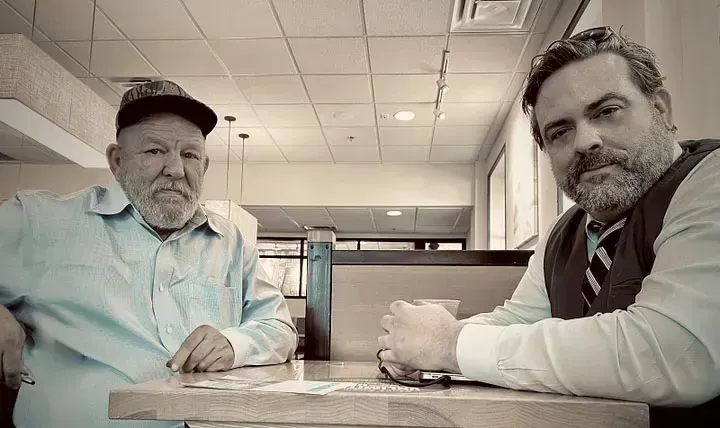
Daniel, a Vietnam Veteran and I having lunch.
By Michael Rentiers December 4, 2025
The last few years have taken me down a path I never expected. During the early days of COVID, when the world felt suspended and my professional work slowed, I found myself working out of a small café in Columbia, SC. One afternoon, a homeless man approached and asked me for money to buy lunch. Instead, I invited him to sit with me. Over sandwiches, he shared his story. He was a Vietnam veteran whose life had unraveled in ways that were gut wrenching to hear and, as I would learn, far too common. I went home and dug into the facts about veteran homelessness. The statistics were jarring, and now they had a face and a name, Daniel. His story stuck with me. I’ve never been one to sit idly by, stepping up never scared me. But what could I possibly do? The answer was simple. Do something. Do anything. Afterall, what have those guys done for me? More than I could ever repay. I kept hearing the same words echo in my mind: If I am only for myself, who am I? If not now, when? I had done PR work for veteran causes before, but this time professional experience didn’t feel like enough. I felt compelled to act personally. So I began spending time on the streets around Columbia, building relationships with the men who had served our country only to have our country fail them. That led to the creation of Without Heroes, a nonprofit dedicated to working directly with homeless veterans one relationship at a time. My theory was simple: transformation begins with consistency and trust. The plan was to intervene in their lives individually to provide the support they need to reach stability. Even if I could only impact one life at a time, that was still meaningful change. Time has passed quickly. The work has been challenging, profound, and humbling. It changed how I see people. It changed how I see service. And it changed how I see the responsibility that comes with having skills that can make an impact. However, I’m returning to my professional world with renewed purpose through my new communications firm, CTA Communications. It’s named after my experience, a Call To Action. I’m bringing back everything I’ve learned…about people, about storytelling, about advocacy, and about what it means to respond when the moment calls. Without Heroes will go on. There is so much work to be done, but it’s time for the next chapter and a return to doing what I love. If you’re interested in getting together, get in touch!
More Posts