Dirtiest Word in Politics: Compromise

How many of you are politically engaged and have bad-mouthed a politician in your party for being open to compromise?
I know there are many of you; it’s become almost a litmus test in primary elections.
I’ll give you the punchline upfront because this isn’t a setup. I’d like you to learn rather than beat you up about it because you’re flat-out part of the problem. You are contributing to the downfall of the most ingenious system of government ever to be established.

I am not only wagging my finger at the right. The two parties are mirror images of one another regarding destructive behavior. There exists within both parties — thus the American people — a thread of willful ignorance that partisans wield like a weapon against rational thought.
Right now, fewer and fewer people, regardless of age, have even a basic understanding of how our system of government works, nor are they familiar with the rationale of the people who created it. Without the basic understanding, there is no shock that our current actions are snapping the bonds that connect us.
I’ll spare you the deep dive into democratic republicanism. (Even the name combines the two parties.) I will instead point you to the founders themselves. If you look at the documents, they produced. At the letters they wrote to one another, speeches they gave, you’d understand one thing — there was never a unified sentiment, and that meant they would never allow a tyranny of the majority. Jefferson was an uncompromising zealot. Yet he penned the world’s two most well-known compromises.

Even our government is a glaring recognition of compromise. Federalism consists of two competing systems of government — compromise was and will always be the lifeblood of our Democracy.
Why do we have a proportional House but an equally distributed Senate? Why a strong national and state government? Even our political parties served as coalition builders where factions disagreed but came together in compromise to form a governing majority.
A compromise was never the end of a politician till now. This trend of shunning a politician for compromising has become a destructive force wielded by those craven for power and the stupid who don’t know or care.
President Reagan was outspoken on compromise. From his autobiography, “An American Life” (Simon & Schuster, 1990), Reagan wrote about his time as Governor of California.
“Compromise” was a dirty word to them, and they wouldn’t face the fact that we couldn’t get all of what we wanted today. They wanted all or nothing, and they wanted it all at once. If you don’t get it all, some said, don’t take anything.
If you got seventy-five or eighty percent of what you were asking for, I say, you take it rather than going over the cliff with your flags flying.
Oh, how we could use that kind of leadership today.
I’ll leave you with one of the most glaring examples that compromise is in the fabric of our government. I invite you to read our most sacred document — The Declaration of Independence. It is a document so powerful it held thirteen independent states together, established this nation, and almost tore us apart as we finally ended the barbaric idea that one man could own another in the Civil War.
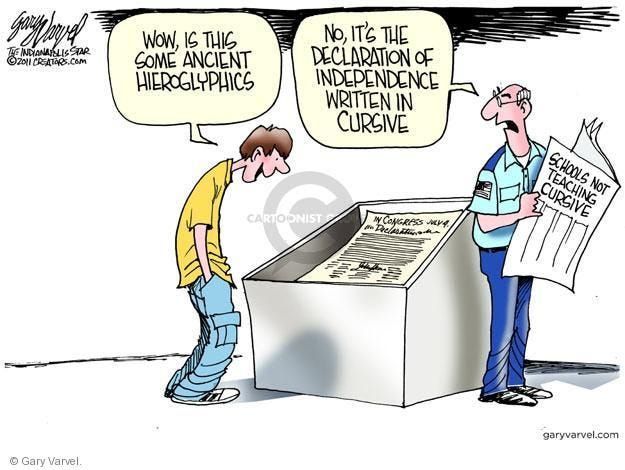
Yet, that same document is an oddly cobbled together compromise. Our framers fought over just what this was supposed to be and how it should be written. Some states felt a deep loyalty to the Crown, while others engaged in a counter-insurgency against British troops. They all worried about how hard to push the King. They were wise to be cautious. They could not just undermine the idea of the monarchy. On the one hand, their King refused to listen. But to win independence, they would need recognition and help from other monarchs.
If you have never read the Declaration, I beg you to take a moment and do so. As esoteric as I sound, it is the very reason you and I do not live in fear of persecution, hunger, or war on our soil. Not all are so lucky — today, now, the majority of the world’s population still lives under constant threat of death from oppression, starvation, curable disease, and wars with no cause.
Maybe you can take a moment?
You might not see it on the first pass, but it is a jumble of revolutionary statements mixed with legal arguments, some hedging of bets, and gnashing of teeth. We all know the preamble that lays out man’s inalienable rights in a brilliant revolutionary statement. It just as forcefully becomes a technocratic legal argument right after. At times it is almost apologetic to the Crown. I hope you read the damn thing.
We could continue for hours on making the constitution and compromise, but the point is made, and the dead horse, freshly whipped.
To all partisans who attack one other with childish name-calling. To those who think a purity test for primary candidates is healthy. And to those who cannot fathom that a Republican from the midwest differs from one in the South or a Democrat in the South differs from those in New England — America’s founding fathers, as well as every great President that as ever served, would like for you to shut the f*ck up and stop ruining everything.
Peace.

If you want to know more about why our systems depend on compromise or how the framers use our worst instincts to create a stabilizing tension in the design, please ask, and let’s discuss it. We are losing so much institutional knowledge, and it’s because those who control the education system are removing it. I am serious when I say that academia in the US is actively subverting the country, which could be outright treason. There is only one reason they have stopped teaching the foundational principles of the USA, and that’s because the only way it fails is from within. These extremists cannot win at the ballot box, so they subvert children’s minds — a long story for another day soon.
News & Opinion